
Home » Weekly Logistics Update
Freight rates remain high, but show signs of stabilizing amid continued Hormuz blockage
The US-Iran ceasefire is holding up, though tensions have escalated yet again this week with a new US operation called “Project Freedom” that will escort ships out of the Strait of Hormuz, and a countermeasure from Iran to deepen its control over the area. Iranian forces fired at two US-flagged vessels and navy ships during an escort on Monday, prompting a response from the US that sank several Iranian boats.
Following this incident, the UAE said it intercepted four missiles fired by Iran, in the first strike on Gulf states to occur in weeks. The same evening, a drone strike caused a fire at the Fujairah Oil Industries Zone (FOIZ). Four attacks on commercial shipping have been reported as of Sunday.
Iran’s response measure to “Project Freedom” established a new “maritime control area” from Mount Mobarak in Iran to Fujirah, UAE in the south, and between Qeshm Island in Iran and Umm Al Quwain in the UAE in the west. The Islamic Revolutionary Guard Corps (IRGC) warned in state media that vessels which cross the line will be “met with severe response from the IRGC Navy and will be destroyed.”
Some analysts say that the US military operation is unlikely to restore traffic through the Strait of Hormuz or boost oil supply in a meaningful way. With the increase in hostilities, the risk perception remains high and will likely deter carriers from making any moves. According to Kuehne + Nagel, the latest seaexplorer data shows 102 container vessels trapped in the Persian Gulf with a combined capacity of 348,842 TEU.
Ocean freight rates ticked up this week, but appear to be past peak acceleration from the conflict. Bunker prices remain a critical cost pressure. Carriers continue to adjust pricing with surcharges and manage capacity via blank sailings and slow steaming, while soft demand from the low-season sustains downward pressure on the market, limiting the success of rate increases. Global container rates rose 1.9% and 2.3% on the Shanghai Containerized Freight Index (SCFI) and Freightos Baltic Index (FBX) respectively, while Drewry’s World Container Index (WCI) fell 0.7%.
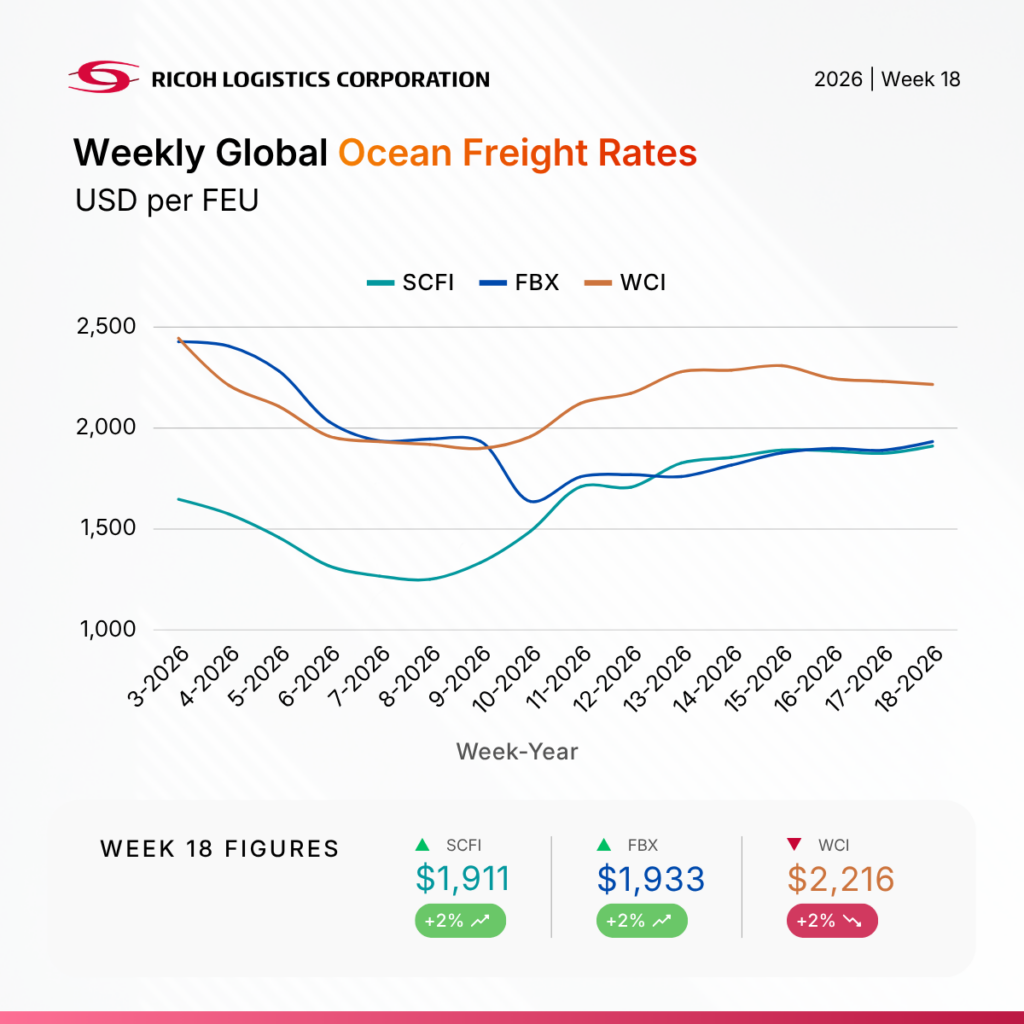
Transpacific rates to the US West Coast and East Coast increased slightly, and remain 52% and 46% higher than pre-crisis levels respectively, Xeneta data shows, driven in part by heavy congestion at Southeast Asian transshipment hubs. Spot rates from the Far East to North Europe have softened more noticeably, with a week over week 7.6% increase in capacity in the midst of soft demand. In the past month, rates have dropped 10%, and Far East to Mediterranean rates fell 15% over the same period.
The air freight market is following a similar trajectory – rates remain elevated, but are seemingly past peak levels driven by the crisis, with capacity gradually recovering and shifting. Industry groups continue to warn of the risk to jet fuel supply as the crisis continues, though no actual confirmed shortages have materialized yet.
Judah Levine, head of research at Freightos, said in a Tuesday research note that rates across most lanes are flat, or have begun to decline from mid-April peaks, but still sit well above pre-war levels. An exception is China – US rates, which are down 7% from late February. Freightos Air Index global rates currently sit 25% above pre-crisis levels.
In an April 28 update to the US Court of International Trade (CIT), Customs and Border Protection (CBP) said that roughly 21% of entries eligible for IEEPA duty refunds had been accepted, and the first of these refunds are expected to be issued around May 11.
It is, however, important to note that the Trump administration has until early June to appeal the court order to issue IEEPA refunds, in which case could result in significant delays.
“Approximately 21% of the total entries that were entered subject to IEEPA duties have been accepted for the removal of IEEPA duties through CAPE, and roughly 3% have been liquidated through CAPE and are in the refund stage of the process, which includes an issuance of the refund from the U.S. Department of the Treasury. Customs anticipates issuing the first refund on or about May 11, 2026,” CBP said in the update.
The update also acknowledges user reports of problems accessing ACE, confusion identifying the correct importer to make a declaration, and questions surrounding the interest rate that applies to refund amounts, and the method CBP uses to calculate this interest. CBP plans to issue guidance and update its CAPE FAQs on its website to address these concerns.
CBP is scheduled to provide the next progress report on CAPE to the CIT on May 12, 2026.
In tariff news, President Trump said in a Truth Social post on May 1 that automobiles manufactured and imported from the EU will be subject to a increased tariff rate of 25% starting next week. Trump said the tariff is “based on the fact the European Union is not complying with our fully agreed to Trade Deal” adding that if they manufacture cars and trucks in US plants, “there will be NO TARIFF.”
In late April, the Federal Maritime Commission (FMC) ordered Orient Overseas Container Line (OOCL) to pay $45.6 million to the bankrupt retailer Bed Bath & Beyond, setting a new record for the largest single reparation award issued by the FMC to date.
The landmark ruling issued by FMC Chief Administrative Law Judge Erin Wirth stems from complaints filed regarding shipping practices during the global supply chain disruptions from the pandemic in 2020-2021. Bed Bath & Beyond accused OOCL of failing to meet its contractual obligations and assessing unfair detention and demurrage (D&D) fees when port congestion prevented the physical retrieval or return of shipping containers.
In the decision, the FMC found that OOCL failed to make a “good faith effort” to provide the capacity it promised, which forced Bed Bath & Beyond to secure more expensive capacity on the spot market. The ruling also found evidence that OOCL retaliated against and refused to deal with the retailer. Judge Wirth added that the violations were “willfully and knowingly committed” and assigned the reparation award of $45.6 million based on the carriers failure to honor space and price commitments, including penalties for retaliation.
Bed Bath & Beyond initially sought $165.4 million, partially over allegations of unfair D&D fees caused by port congestion, but Judge Wirth ruled in OOCL’s favor regarding this complaint, concluding that “some of OOCL’s concerns are well-founded” and that no violations had been committed pertaining to unreasonable D&D practice
This ruling could potentially set a precedent for carrier obligations, specifically that periods of severe market disruption do not exempt them from honoring contractual requirements. However, the decision is still subject to a review by the Commission or potential appeals before it becomes final. Both sides have 22 days from the decision date (April 24) to file an exception.